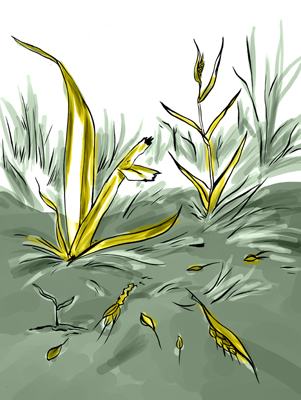
Grasses
Each grass plant will occupy a 10 x10 cm square (and thus has one kelov of bioenergy available to it each month).
When a seed germinates, each seedling will eventually reach maturity and cast seeds. In this simulation, no grass plant ever dies.
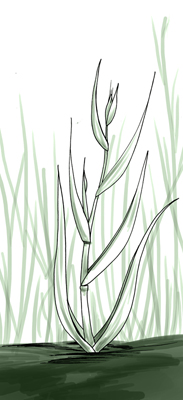
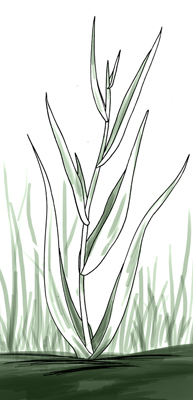
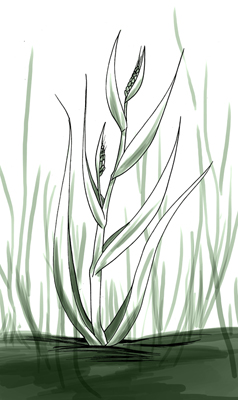
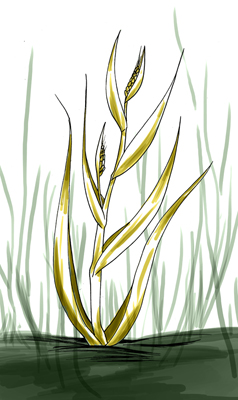
Grasses grow through seven stages: seed, seedling, tiller, early broadleaf, late broadleaf, boot, header, and turn. Each stage has its specific characteristics.
Seeds
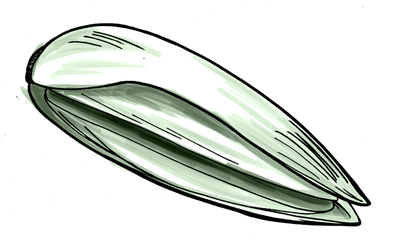
These are the seeds that have been knocked down from the turns and are now lying on the ground. They have not yet sprouted and will be the food source for the mice. Each month, a certain percentage of seeds are able to sprout pending available vacant spots. Another certain percentage of seeds will rot, thus disappearing from the ecosystem’s seed inventory.
Seedling
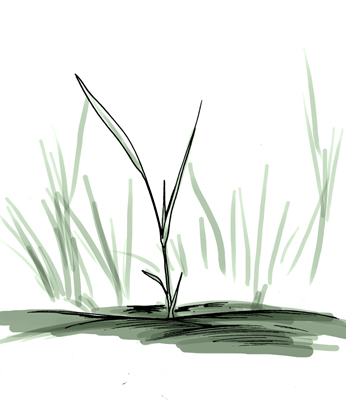
The seeds have sprouted. Early leaves are gathering whatever sunlight that falls on them to grow bigger.
Tiller
Tillers are seedlings that have expanded their leaf structure to gain more of the sun's energy.
Early BroadLeaf
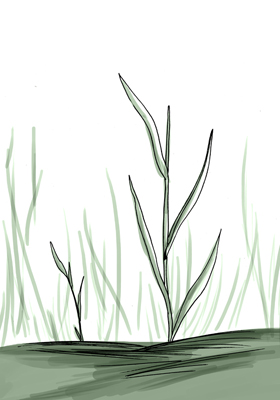
The early broadleaf stage now captures more sunlight in two ways. Its leaf structure improves, thus preventing less sunlight from going past the plant. As well, the plant height increases, the plant can now take energy from a higher level, as well as its lower level when it was a seedling or tiller.
Late Broadleaf
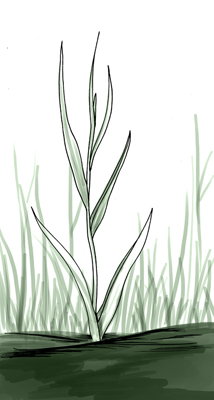
Like the early broadleaf stage, the late broadleaf adds more leaves and height to capture more sunlight.
Boot Stage
The plant has stopped growing at this stage and is putting all its energy into making seeds. In this stage, the seeds are forming inside the top stalks. All the sun's energy is going into making the seeds.
Header Stage
The seed head is now exposed and seeds are ripening. All the sun's energy is still going into the seeds.
Turn Stage
The ripening is complete. All leaves and stalks are turning from green to yellow, as the plant has converted some of its energy stored in the leaves and stalks into the seeds. The plant effectively dies, and thus the roots, stalks, and leaves are no longer counted in the biomass and bioenergy calculations. However the seeds are still counted in the turn's biomass and bioenergy and the number of standing turns is still included in the bionumbers because they are occupying spaces that prevent new grasses from starting.
Despite the demise of the plant, it is still quite strong. It will hold its seeds high until weather or animal activity knock it down.
Casting Seeds
Each month, the weather will knock down a certain percentage of the standing turns. Animals travelling through the grasses will also knock down turns. When a turn is knocked down, its seeds are released for mice to feed on or create new seedlings. As turns are knocked down, they are removed from the bionumbers, and this creates a space for new seedlings. The biomass and bioenergy stored in their seeds is no longer counted as grass biomass and bioenergy. Instead, this transfer of seeds from turns to the ground is shown as the density of “seeds on the ground”.
Grass Biofacts
The following table gives the average bioenergy and biomass for one plant at each of its stages. This table might be useful to discover some other correlations.
Grass Stage Bioengergy per plant
(kelov)Biomass
(kg of seeds, roots, stalks, & leaves)Seed 0.0909 0.00007 Seedling 0.1127 0.07700 Tiller 0.2230 0.15234 Early Broadleaf 0.5598 0.38232 Late Broadleaf 1.3135 0.89709 Boot 2.4284 1.24273 Header 3.6476 1.24361 Turn (seeds only) 2.5674 0.00185
Science · Laboratory · Ecosystem · Quest · Laboratory Trials · Ecosystem Trials · Quest Trials
Discussion · Journal · Hall of Fame · Design · Participation · Contacts & Credits